
Why wrestling, chasing and big-body play are essential for children’s development
In many educational settings, rough and tumble play, wrestling, chasing, playful fighting, and rolling around, can make adults uneasy. It looks chaotic, noisy, and sometimes close to aggression. Yet decades of research in developmental psychology, neuroscience, and ethology suggest that rough and tumble play is not only normal, but deeply beneficial.
From a playwork perspective, rough and tumble play is one of the most natural and biologically embedded forms of play that children engage in. It sits alongside several of Bob Hughes’ play types, particularly rough and tumble play, deep play, and social play (in fact these play types often happen together not in isolation). These play forms allow children to explore physical competence, negotiate relationships, and experience risk within the protective boundaries of play.
Understanding rough and tumble play means understanding that what looks chaotic from the outside is often a sophisticated developmental process.

Rough and Tumble Play in the Playwork Tradition
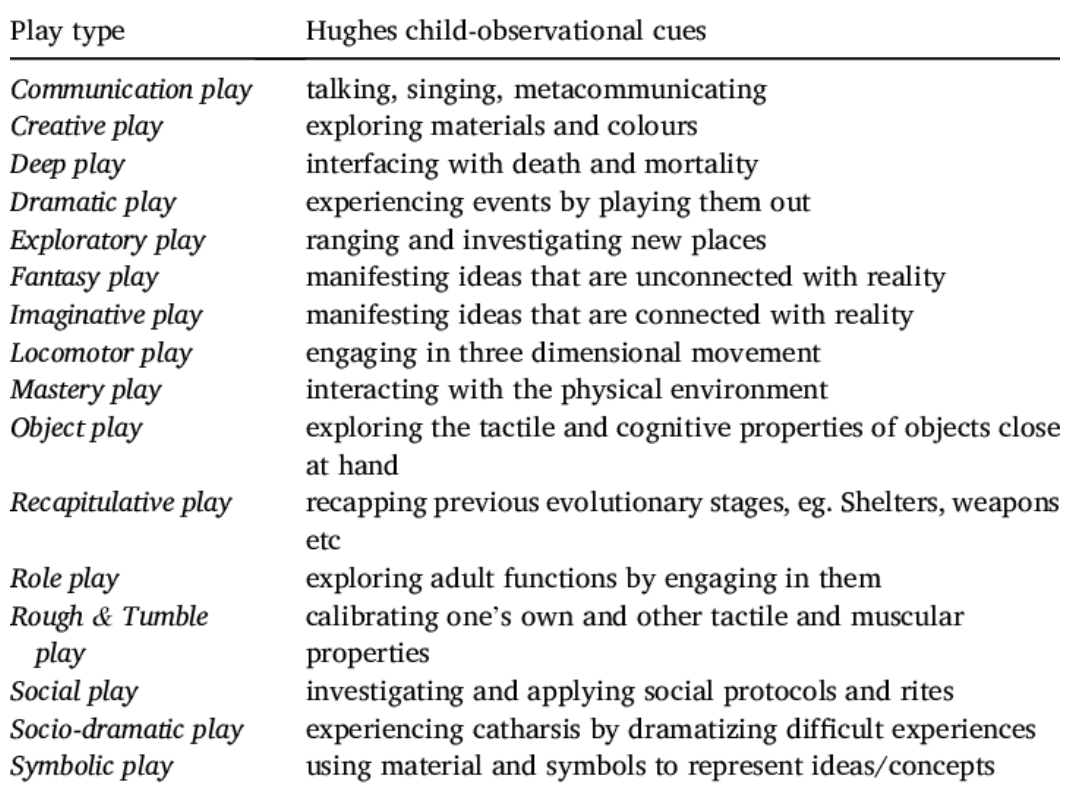
Playwork theory recognises rough and tumble play (as one of 16 play types), as an important category of play behaviour. Bob Hughes describes it as a form of physical contact play that mimics fighting but is driven by mutual enjoyment rather than intent to harm.
Within playwork practice, the presence of laughter, exaggerated movements, pauses, and reciprocal engagement are signals that distinguish play fighting from real aggression.
In fact, this negotiation between competition and cooperation is one of the defining features of rough and tumble play. Participants compete physically but also constantly regulate the interaction so that the game continues. In this way, children are simultaneously testing limits and protecting the social relationship.
Research suggests that rough and tumble play requires children to balance two opposing motivations: the desire to “win” and the desire to keep the play going. This dynamic helps children learn to navigate ambiguous social situations and develop nuanced social skills. (OUP Academic)
For playworkers, this reinforces a key principle: children are practicing complex social competencies in environments where they feel safe enough to explore them.
A Behaviour Shared Across the Mammalian World
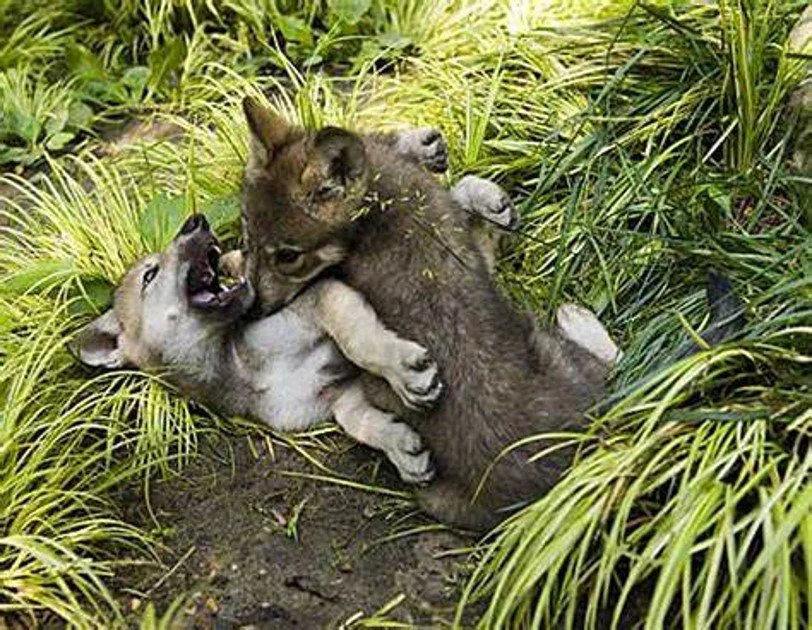
Rough and tumble play is not unique to humans. It appears widely across the mammalian world, from rats and primates to dolphins and canines.
Play fighting involves behaviours that resemble real aggression; pushing, biting, wrestling, but performed with signals that maintain cooperation and prevent escalation. These signals help partners understand that the interaction is playful rather than hostile. (National Institute for Play)
Young mammals across many species engage in this type of play during juvenile periods. The widespread presence of rough and tumble play suggests that it has evolutionary value. It likely helps develop the motor, social, and emotional skills needed for survival and social living.
In many mammalian species, young animals that engage more in play fighting develop stronger social competence as adults. (The Strong National Museum of Play) Seen through this lens, rough and tumble play is not chaotic behaviour—it is a biological training ground for social life.
The Social Brain: What Neuroscience Tells Us
Neuroscience research has increasingly demonstrated that play has measurable effects on brain development.
Studies of juvenile rats, one of the most common models used in play research, show that social play helps organise and develop brain systems involved in social behaviour. Experiences gained during play can produce changes in cortical areas responsible for interpreting social information and responding appropriately. (National Institute for Play)
Two brain areas often discussed in relation to play are:
The Prefrontal Cortex
The prefrontal cortex is responsible for impulse control, decision-making, and social judgement. Rough and tumble play requires children to constantly regulate their actions—pulling punches, stopping when someone signals discomfort, and adjusting behaviour to keep the game going.
These micro-negotiations help exercise the developing prefrontal systems responsible for self-regulation.
The Hippocampus
The hippocampus plays a critical role in memory formation and spatial awareness. Physical, socially rich play environments stimulate neural plasticity and support the growth of new neural connections within this region.
In simple terms, the brain grows through experiences that combine movement, emotion, and social interaction—exactly the ingredients present in rough and tumble play.
Oxytocin, Touch and Mammalian Bonding
Physical play also interacts with the body’s neurochemical systems.
One key hormone involved is oxytocin, often called the “bonding hormone.” Oxytocin is released through positive physical touch and social interaction. Research with juvenile rats shows that playful tactile interactions—similar to rough and tumble play—activate oxytocin systems in the brain and increase social bonding responses. (Nature)

This chemical response helps explain why rough and tumble play often involves laughter, joy, and strong social connection. The rough physical contact that can appear aggressive from the outside is often accompanied internally by a cascade of bonding chemicals that reinforce relationships and emotional safety.
In other words, rough and tumble play may help children learn that intense physical interaction can coexist with trust and affection.

What Anthony D. Pellegrini’s Research Shows
Few researchers have studied rough and tumble play as extensively as developmental psychologist Anthony D. Pellegrini.
Pellegrini’s work demonstrated several important findings:
1. Rough and tumble play is not the same as aggression
Observational studies of playgrounds found that although rough play can appear aggressive, genuine aggression occurred extremely rarely within these interactions. (ScienceDirect)
Children typically use clear play signals—smiling, laughter, exaggerated movements—to maintain the playful context.

2. It supports social competence
Pellegrini found correlations between engagement in rough and tumble play and higher levels of social competence among peers. (ScienceDirect)
Children who participated in this type of play often demonstrated better abilities to interpret social cues and navigate complex social interactions.
3. It strengthens peer relationships
Research also suggests rough and tumble play helps children learn to differentiate playful behaviour from real aggression—a skill linked with stronger peer relationships and popularity within social groups. (The Daily Declaration)
In this way, rough and tumble play becomes a practice ground for social literacy.
Self-Regulation and Emotional Control
One of the most valuable developmental outcomes of rough and tumble play is the cultivation of self-regulation.
To keep the game going, children must constantly monitor:
The strength of their movements
Their partner’s reactions
The unwritten rules of the game
The emotional tone of the interaction
If they go too far, the play stops.
This immediate feedback loop teaches children something powerful: control over their own bodies and emotions affects relationships.
Rather than encouraging aggression, rough and tumble play often helps children learn to regulate it.
Implications for Playwork and Play Spaces
For playworkers and educators working in free play environments, rough and tumble play can present a dilemma. Adult instincts often push toward intervention.
Yet when viewed through developmental, evolutionary, and neurological perspectives, rough and tumble play emerges as an essential part of children’s play repertoire.
The playwork role is not to eliminate it, but to support environments where it can occur safely.
This means:
Providing adequate space
Observing play cues rather than appearances
Intervening only when consent or safety breaks down
Trusting children’s capacity to negotiate play
Adventure playgrounds, loose parts environments, and open play spaces often provide ideal conditions for this type of embodied, social play.

Embracing Big Body Play
Rough and tumble play reminds us that children do not learn only through quiet reflection or structured activities. They learn through bodies colliding, laughter erupting, and the joyful chaos of shared experience. Within these energetic moments, children are building brains, relationships, and resilience. What looks like disorder is often development in motion. And sometimes, the most sophisticated learning happening in a play space is simply two children rolling in the grass, wrestling, laughing—and then getting up to do it all over again.
One thing we know for sure about rough and tumble play is that it has always be around, and despite meeting the ire of many an adult, it has shown no signs of going away… From this Playworkers perspective, that is a great reason to learn more about this type of play, as opposed to pretend I can simply pretend I can make it dissapear.
Angus Gorrie
