
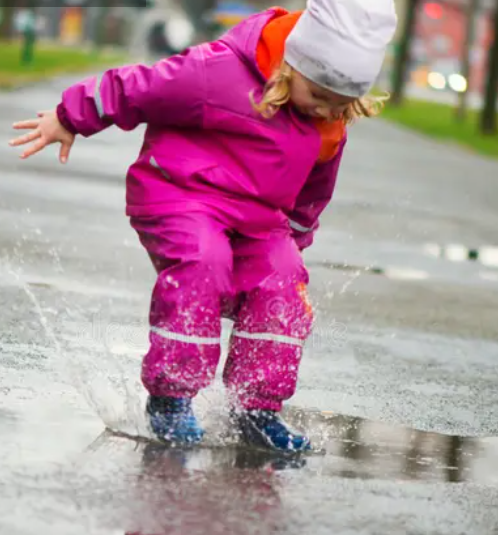
Ever present and often seen as a nuisance, weather is an absolute staple “affordance” in play settings…
Be it sun, rain or snow, the impact of weather, or weather related phenomenon is significant… However, it is so often given no additional consideration beyond managing or avoiding it…
Why don’t we harness it?
Coming into a QLD summer, key weather conditions those working in play settings are likely to contend with are rain, and heat (I have personally hung up my fire cooking kit until middle next year that is for sure). To harness weather, we must not think of the, from an affective Playwork perspective, impact of the weather on play… But rather… What does the weather “suggest”…
For the sake of this blog piece we will lean into the theory of “Affordance” to help articulate how this process can work. In 1979 James Gibson stated…
“The affordances of the environment are what it offers the animal, what it provides or furnishes, either for good or ill. The verb to afford is found in the dictionary, the noun affordance is not. I have made it up. I mean by it something that, refers to both the environment and the animal in away that no existing term does. It implies the complementarity of the animal and the environment”. (Gibson, 1979, p. 127)
As a result, Affordance is now of course “an existing term”.
Gibson (1979) discusses affordance as an ecological niche which characterizes the suitability of the environment for the observer or user, or their ability to make it suitable. For an example, consider from adult perspective chairs set up in room. How they are set up, in a circle, rows, or stacked against the wall with dim lights and a disco ball spinning, all create a unique affordance. It is the same room, with the same chairs, but with a different presentation, that then offers or suggests something entirely different (Armitage, 2019). From the perspective of affordance as it relates to play, a flat rectangular sporting field offers very little affordance. It is perfect for a niche of playing a sporting game or running around, but is suitable, or able to be made so by very few others (Gorrie & Jordinson, 2023).

So what does it matter?
It matters because what can deduce from this is weather, like resources and space are “telling” children how, where and even why to play… A puddle says, “jump in me”, an overflowing down pipe says, “stand under me and get wet”, overwhelming heat says, “find a shady cooler space” and… Impending rain can say “build a shelter”!
But do our resources and practices allow these very natural reactions to environmental affordance manifest?
Despite this very obvious weather derived affordances it is still common to see adult practitioners benign to the impact, somewhat perplexed at the children’s response to said affordances or, and maybe worse, becoming frustrated with such behaviour, and even creating rules limiting the nature biological play drive of the children.
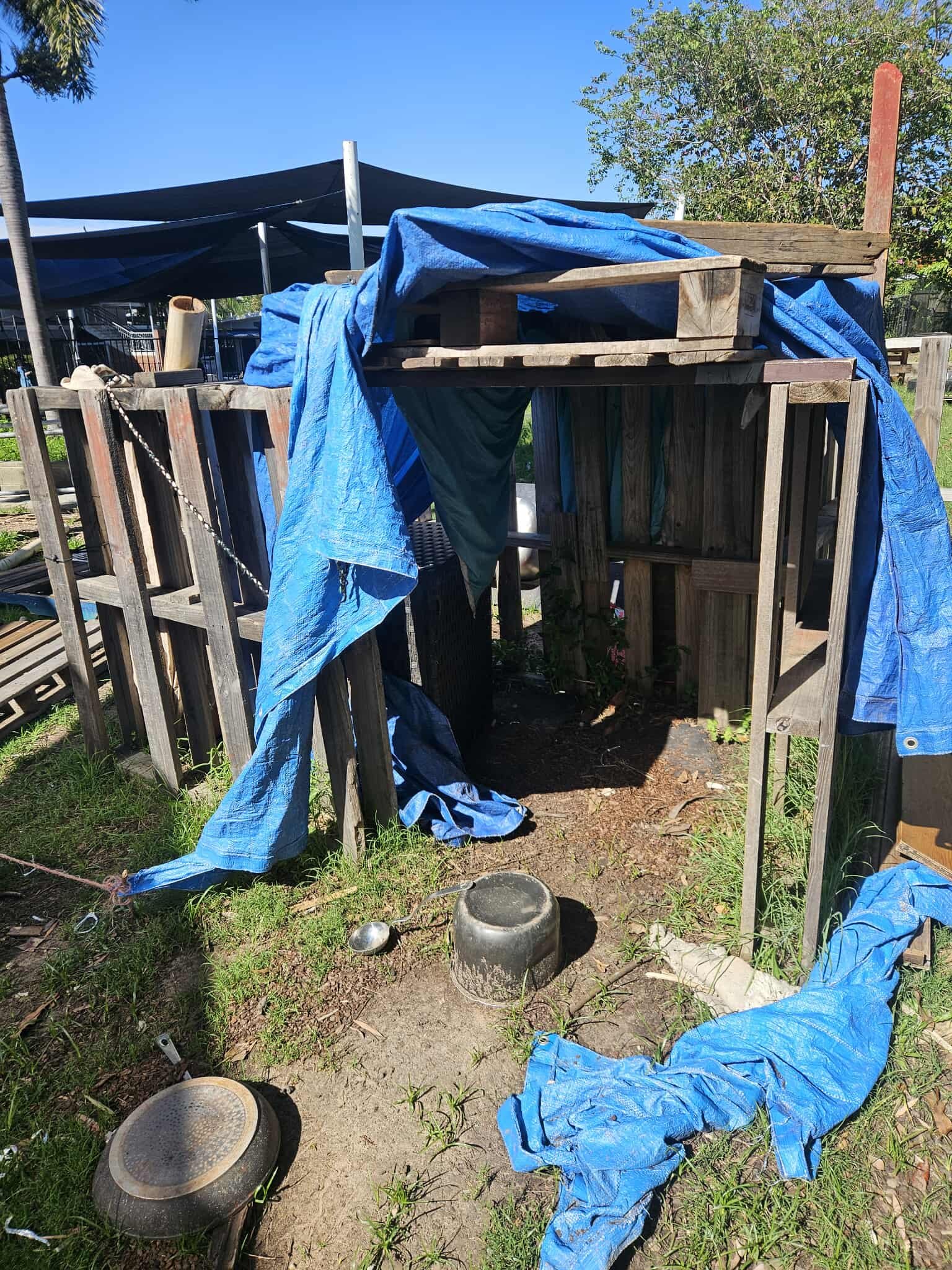
Shade created where none existed previously…
While sensible boundaries and practice is appropriate in a play space… There are often many that are “just because” rules based on circumstance and sometimes convenience. These rules, while sometimes making black and white paperwork sense, can often restrain play to the point, that the push back becomes challenging. In effect, in an effort to maintain order, we open the door to chaos. From a Playwork perspective it is fun to challenge these chaos creating rules and create more “what if” moments…
What if the kids had gum boots..?
Is light rain in 30 degree heat really going to cause all these children to catch colds?
What if they could play in the rain in the afternoons with parent consent..?
What if there were more tarps and sheets for children to build shade and shelter..?
What is there were resources children could use to dam that flowing water..?
There is no answer to these questions, and they may vary from site to site, but this is the process of getting critically reflective.
Overall, weather is a huge affordance to play… We can seek to harness affectively to support the play opportunities for children… Or one we can be at the mercy of.
Armitage, M. (2019). PD At Camp Hill OSHC. Brisbane.
Gibson, J. (1979). The Ecological Approach to Visual Perception. In H. M. Harcourt, The Theory of Affordances (pp. 127–137). New Jersey: Lawrence Erlbaum Associates.
Gorrie, A. & Jordinson, C (2023) Using theories that pertain to space and geography in Australian Outside School Hours settings: Playworkers perspectives. (pp 78-92). International Journal forResearch on Extended Education, Vol. 11, Issue 1/2023